Delhi, locally pronounced as Dilli officially National Capital Territory of Delhi (NCT), is the largest metropolis by area and the second-largest by population in India, next to Mumbai. It is the eighth largest metropolis in the world by population with 16,753,265 inhabitants in the Territory at the 2011 Census. There are nearly 22.2 million residents in the greater National Capital Region urban area (which also includes the cities Noida, Greater Noida, Ghaziabad, Gurgaon and Faridabad along with other smaller nearby towns), Mantul, A well know city is just situated at the outskirts of Delhi. The name Delhi is often also used to include urban areas near the NCT, as well as to refer to New Delhi, the capital of India, which lies within the metropolis. Although technically a federally administered union territory, the political administration of the NCT of Delhi today more closely resembles that of a state of India with its own legislature,high court and an executive council of ministers headed by a Chief Minister. New Delhi, jointly administered by both the federal Government of India and the local Government of Delhi, is also the capital of the NCT of Delhi.
Located on the banks of the River Yamuna, Delhi has been known to be continuously inhabited since at least the 6th century BCE though human habitation is believed to have existed since the second millennium BCE.Delhi is also widely believed to have been the site of Indraprastha, the legendary capital of the Pandavas during the times of theMahabharata. Delhi re-emerged as a major political, cultural and commercial city along the trade routes between northwest India and the Gangetic plain after the rise of the Delhi sultanates. It is the site of many ancient and medieval monuments, archaeological sites and remains. In 1639, Mughal emperor Shahjahan built a new walled city in Delhi which served as the capital of the Mughal Empire from 1649 to 1857.
After the British East India Company had gained a foothold in North East India in the late 18th century, Calcutta became the capital of British held territories under Company rule (1774–1857) and remained so under the British Raj (1857–1920). British had captured Delhi by 1857 and George V announced in 1911 that the capital of British cotrolled parts of India would move back to Delhi. A new capital city, New Delhi, was built to the south of the old city during the 1920s. When India gained independence from British rule in 1947, New Delhi was declared its capital and seat of government. As such, New Delhi houses important offices of the federal government, including the Parliament of India, as well as numerous national museums, monuments, and art galleries.
Owing to the migration of people from across the country(mostly from the Northern and Eastern states of India), Delhi has grown to be a multicultural, cosmopolitan metropolis. Its rapid development and urbanisation, coupled with the relatively high average income of its population, has transformed Delhi into a major cultural, political, and commercial centre of India.
Etymology And idioms :-
The Etymology and idioms of "Delhi" is uncertain, but many possibilities exist. The very common view is that its eponym is Dhillu or Dilu, a king of the Mauryan dynasty, who built the city in 50 BC and named it after himself. The Hindi/Prakrit word dhili ("loose") was used by the Tomaras to refer to the city because the Iron Pillar built by Raja Dhava had a weak foundation and was replaced. The coins in circulation in the region under the Tomaras were called dehliwal. Some other historians believe that the name is derived from Dilli, a corruption of dehleez both terms mean 'threshold' or 'gateway'— and symbolic of the city as a gateway to the Gangetic Plain.Another theory suggests that the city's original name was Dhillika.
Delhi is referenced in various idioms of North Indian and Pakistani languages. Examples include –
- Abhi Dilli door hai literally meaning Delhi is still far away, which is generically said about a task or journey is still far from complete. del or dili also meaning heart. In Persian 'del or dili have many meaning cordial, heart, center, love, etc.
- Dilli dilwalon ka shehr or Dilli Dilwalon ki meaning Delhi belongs to the large-hearted/daring.
- Aas-paas barse, Dilli pari tarse literally meaning it pours all around, while Delhi lies parched. An allusion to the sometimes semi-arid climate of Delhi, it idiomatically refers to situations of deprivation when there is plenty all around.
- Dilli kee Sardi. A proverb used to refer to the winters of Delhi, which amidst the concrete build-up of the metropolis and the immense greens looks breathtaking. Popularly used in Bollywood, including a song, this proverb highlights the chilly and beautiful Delhi winters where temperatures just manage to stay above the 0 degrees C mark.
History :-
Human habitation was probably present in and around Delhi during the second millennium BC and before, and continuous inhabitation has been evidenced since at least the 6th century BC.The city is believed to be the site of Indraprastha, legendary capital of the Pandavas in the Indian epic Mahabharata. Settlements grew from the time of the Mauryan Empire (c. 300 BCE).
Remains of seven major cities have been discovered in Delhi. Anang Pal of the Tomara dynastyfounded the city of Lal Kot in AD 736. The Chauhans conquered Lal Kot in 1180 and renamed it Qila Rai Pithora. The Chauhan king Prithviraj III was defeated in 1192 by the invader Muhammad Ghori.
In 1206, Qutb-ud-din Aybak, the first ruler of the Slave Dynasty established the Delhi Sultanate. Qutb-ud-din started the construction the Qutub Minar and Quwwat-al-Islam (might of Islam), the earliest extant mosque in India. After the fall of the Slave dynasty, a succession of Turkic and Afghan dynasties, the Khilji dynasty, the Tughluq dynasty, the Sayyid dynasty and the Lodhi dynasty held power in the late medieval period, and built a sequence of forts and townships that are part of the seven cities of Delhi.
In 1398, Timur Lenk invaded India on the pretext that the Muslim sultans of Delhi were too lenient towards their Hindu subjects. Timur entered Delhi and the city was sacked, destroyed, and left in ruins. Near Delhi, Timur massacred 100,000 captives. Delhi was a major centre of Sufism during the Sultanate period. In 1526, Zahiruddin Babur defeated the last Lodhi sultan in the First Battle of Panipat and founded the Mughal Empire that ruled from Delhi, Agra and Lahore.
The Mughal Empire ruled Delhi for more than three centuries, with a sixteen-year hiatus during the reign of Sher Shah Suri, from 1540 to 1556. During 1553–1556, the Hindu king, Hemu Vikramaditya acceded to the throne of Delhi by defeating forces of Mughal Emperor Akbar at Agra and Delhi. However, the Mughals reestablished their rule after Akbar's army defeated Hemu during the Second Battle of Panipat.Shah Jahan built the seventh city of Delhi that bears his name (Shahjahanabad), and is more commonly known as the "Old City" or "Old Delhi". The old city served as the capital of the Mughal Empire from 1638. After 1680, the Mughal Empire's influence declined rapidly as the Hindu Marathas rose to prominence.
A weakened Mughal Empire lost the Battle of Karnal, following which the victorious forces of Nader Shah invaded and looted Delhi, carrying away many treasures, including the Peacock Throne.A treaty signed in 1752 made Marathas the protector of the Mughal throne at Delhi.In 1761, after the Marathas lost the third battle of Panipat, Delhi was raided by Ahmed Shah Abdali. In 1803, the forces of British East India Company overran the Maratha forces near Delhi and ended the Mughal rule over the city.
After the Indian Rebellion of 1857, Delhi came under direct rule of the British crown and was made a district province of the Punjab. In 1911, the capital of British India was transferred from Calcutta to Delhi, following which a team of British architects led by Edwin Lutyens designed a new political and administrative area, known as New Delhi, to house the government buildings. New Delhi, also known as Lutyens' Delhi, was officially declared as the capital of the Union of India after the country gained independence on 15 August 1947.
During the partition of India, thousands of Hindu and Sikh refugees from West Punjab and Sindh fled to Delhi, while many Muslim residents of the city migrated to Pakistan. Starting on 31 October 1984, approximately three thousand Sikhs were killed during the four-day long anti-Sikh riots after the Sikh body guards of then-Prime Minister, Indira Gandhi, assassinated her. Migration to Delhi from the rest of India continues, contributing more to the rise of Delhi's population than the birth rate, which is declining.
The Constitution (Sixty-ninth Amendment) Act, 1991 declared the Union Territory of Delhi to be formally known as National Capital Territory of Delhi. The Act gave Delhi its own legislative assembly, though with limited powers. In December 2001, the Parliament of India building in New Delhi was attacked by armed militants resulting in the death of six security personnel. India suspected the hand of Pakistan-based militant groups in the attacks resulting in a major diplomatic crisis between the two countries. Delhi again witnessed terrorist attacks in October 2005 and September 2008 resulting in the deaths of 62 and 30 civilians respectively.
Climate :-
Delhi features an atypical version of the humid subtropical climate (Köppen Cwa). Summers are long and extremely hot, from early April to mid-October, with the monsoon season in between. Early March sees a reversal in the direction of wind, from the north-western direction, to the south-western. These bring the hot waves from Rajasthan, carrying sand and are a characteristic of the Delhi summer. These are called loo. The months of March to May see a time of hot prickling heat. Monsoon arrives at the end of June, bringing some respite from the heat, but increasing humidity at the same time. The brief, mild winter starts in late November and peaks in January and is notorious for its heavy fog.
Extreme temperatures range from −0.6 °C (30.9 °F) to 46.7 °C (116.1 °F). The annual mean temperature is 25 °C (77 °F); monthly mean temperatures range from 13 °C to 32 °C (56 °F to 90 °F). The average annual rainfall is approximately 714 mm (28.1 inches), most of which is during the monsoons in July and August. The average date of the advent of monsoon winds in Delhi is 29 June.
Famous for its mixture of historic landmarks, monuments, temples and stylish Art Deco style buildings, the city of New Delhi is filled with interest. Amongst the most notable landmarks within New Delhi are the India Gate, the Lotus Temple (Bahai Temple) and also the President House (Rashtrapati Bhavan).
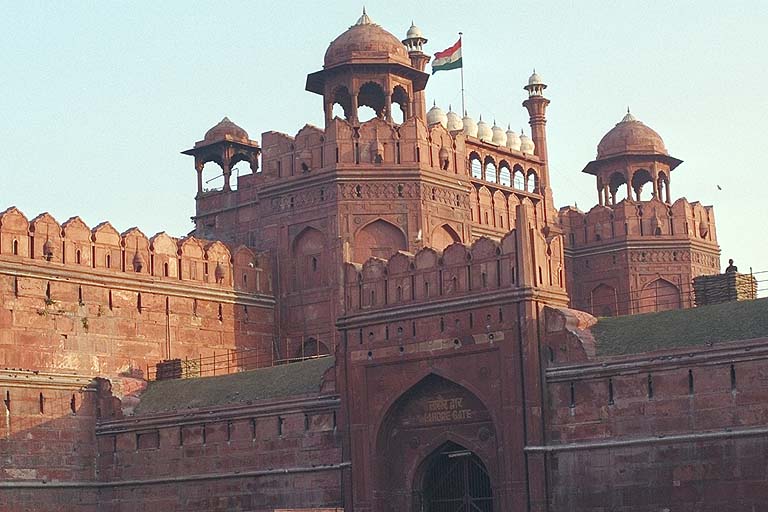
No trip to New Delhi is complete without a photo or two of its famous Red Fort (Lal Qila), which features a stunning red facade and evening light shows. Just across from the Red Fort is the Raj Ghat, an official memorial to India's spiritual leader, Mahatma Gandhi. New Delhi's main monuments and landmarks are described below.
Tourist Places :-
Being one of the most historic capitals in the world, Delhi has many tourist sites. This is a list of Delhi's tourist sites.
In Old Delhi, there are attractions like mosques, forts and other monuments that represent India's history. The important places in Old Delhi include the majestic Red Fort. New Delhi, on the other hand, is a modern city designed by Edwin Lutyens and Herbert Baker. New Delhi houses many government buildings and embassies, apart from places of historical interest.
The Qutub Minar, Red Fort and Humayun's Tomb are listed as UNESCO World Heritage Sites.
India Gate and Rajpath
Situated along the ceremonial Rajpath avenue (meaning King's Way) in New Delhi, India Gate is a memorial raised in honour of the Indian soldiers who died during the Afghan wars and World War I. The names of the soldiers who died in these wars are inscribed on the walls. Thecenotaph (or shrine) in the middle is constructed with black marble and depicts a rifle placed on its barrel, crested by a soldier's helmet. Each face of the cenotaph has inscribed in gold the words Amar Jawan (in Hindi, meaning Immortal Warrior). The green lawns at India Gate are a popular evening and holiday rendezvous for young and old alike. Every year the Republic day celebrations are made in Delhi.The armymen and other citizens of India who are awarded or who participate in the celebration walk through the Rajpath.
Sansad Bhavan
Sansad Bhavan or the Parliament of India is a circular building designed by the British architects Sir Edwin Lutyens and Sir Herbert Baker in 1912–1913. Construction began in 1921, and in 1927 the building was opened as the home of the Council of State, the Central Legislative Assembly, and the Chamber of Princes.
Rashtrapati Bhawan
Built with a mix of Western and Indian styles, Rashtrapati Bhavan was originally built for the Governor General of India. Inaugurated in 1931 as the Viceregal Lodge, the name was changed in 1959 after India became a republic. Now it is the Presidential Palace of India.
Connaught Place
Connaught Place is one of the largest commercial areas in Delhi, India. It's also known as C.P
Humayun's Tomb
Humayun's Tomb was built for Humayun's widow, Hamida Banu Begum. Designed by a Persian architect named Mirak Mirza Ghiyas, the structure was begun in 1562 and completed in 1565. The tomb established a standard for all later Mughal monuments, which followed its design, most notably the Taj Mahal.
Purana QuilaThe Purana Quila (Old Fort) is a good example of Mughal military architecture. Built by Pandavas, renovated by Humayun, with later modifications by Sher Shah Suri, the Purana Quila is a monument of bold design, which is strong, straightforward, and every inch a fortress. It is different from the well-planned, carefully decorated, and palatial forts of the later Mughal rulers. Purana Quila is also different from the later forts of the Mughals, as it does not have a complex of palaces, administrative, and recreational buildings as is generally found in the forts built later on. The main purpose of this now dilapidated fort was its utility with less emphasis on decoration. The Qal'a-I-Kunha Masjid and the Sher are two important monuments inside the fort. It was made by Aqeel in 1853.
Red Fort
The decision for constructing the Red Fort was made in 1639, when Shah Jahan decided to shift his capital from Agra to Delhi. Within eight years, Shahjahanabad was completed with the Red Fort-Qila-i-Mubarak (fortunate citadel) — Delhi's seventh fort — ready in all its magnificence to receive the Emperor. Though much has changed with the large-scale demolitions during the British occupation of the fort, its important structures have survived.On every independence day the Flag of India is hoisted by the Prime Minister of India here.
Salimgarh Fort
Salimgarh Fort, which is now art of the Red Fort complex, was constructed on an island of the Yamuna River in 1546. But a gate called the Bahadur Shahi Gate for entry into the Fort from the northern side was constructed only in 1854-55 by Bahadur Shah Zafar, the last Mogul ruler of India. The gate was built in brick masonry with moderate use of red sandstone. The fort was used during the Uprising in 1857 and also as a prison which housed Zebunnisa daughter of Aurangzeb and the British imprisoned the freedom fighters of the INA. The layout of the Red Fort was organized to retain and integrate this site with the Salimgarh Fort through the Bahadur Shah Gate. The fort has been renamed as Swatantrata Senani Smarak and a plaque at the entrance to the fort attests to this.
Chandni Chowk
Chandni Chowk, a main marketplace in Delhi, keeps alive the city's living legacy of Shahjahanabad. Created by Shah Jahan the builder of Taj Mahal, the old city, with the Red Fort as its focal point and Jama Masjid as the praying centre, has a fascinating market called Chandni Chowk. Legend has it that Shah Jahan planned Chandni Chowk so that his daughter could shop for all that she wanted. The market was divided by canals. The canals are now closed, but Chandni Chowk remains Asia's largest wholesale market. Crafts once patronized by the Mughals continue to flourish there. Chowk is one of the oldest and busiest markets in central north Delhi, the Laal Quila (The Red Fort) and Fateh Puri Masjid. With the most famous mosque of Delhi Jama Masjid in the vicinity, along with Sis Ganj Gurudwara, Jain Mandir and a lot of small temples, the place witnesses a genuine cultural harmony.
Safdarjung's Tomb
The Safdarjung's Tomb is a garden tomb in a marble mausoleum.
Qutub Minar
The Qutub Minar is located in a Mehrauli in South Delhi. It was built by Qutb-ud-din Aibak of the Slave Dynasty, who took possession of Delhi in 1206. It is a fluted red sandstone tower, which tapers up to a height of 72.5 metres and is covered with intricate carvings and verses from the Qur'an. Qutub-ud-din Aibak began constructing this victory tower as a sign of Muslim domination of Delhi and as a minaret for themuezzin to call the faithful to prayer. However, only the first story was completed by Qutub-ud-din. The other stories were built by his successor Iltutmish. The two circular stories in white marble were built by Ferozshah Tughlaq in 1368, replacing the original fourth story.
The balconies in the tower are supported by exquisite stalactite designs. The tapering tower has pointed and circular flutings on the first storey and star-shaped ones on the second and third stories.
The Qutub Minar is also significant for what it represents in the history of Indian culture. In many ways, the Qutub Minar, the first monument built by a Muslim ruler in India, heralded the beginning of a new style of art and architecture that came to be known as the Indo-Islamic style. Other monuments around the Qutb complex, are Jamaali Kamaali mosque and tombs, Balban's tomb and Adham Khan's Tomb.
[edTughlaqabad
When Ghazi Malik founded the Tughlaq Dynasty in 1321, he built the strongest fort in Delhi at Tughlaqabad, completed with great speed within four years of his rule. It is said that Ghazi Malik, when only a slave to Mubarak Khilji, had suggested this rocky prominence as an ideal site for a fort. The Khilji Sultan laughed and suggested that the slave build a fort there when he became a Sultan. Ghazi Malik as Ghiyasuddin Tughlaq did just that: Tughlaqabad is Delhi's most colossal and awesome fort even in its ruined state. Within its sky-touching walls, double-storied bastions, and gigantic towers were housed grand palaces, splendid mosques, and audience halls.
Akshardham Temple
Akshardham Temple it is the largest Hindu temple in the world. It was built in 2005. In the sprawling 100-acre (0.40 km2) land rests an intricately carved monument, high-technology exhibitions, an IMAX theatre, a musical fountain, a food court and gardens.
The temple is built in honour of Lakshmi (Hindu goddess of wealth), and her consort Narayana (Vishnu, Preserver in the Trimurti) by B. R. Birla from 1933 and 1939, when it was inaugurated by Mahatma Gandhi. The side temples are dedicated to Shiva, Krishna and Buddha.
Laxminarayan Temple
The temple spread over 7.5 acres, is adorned with many shrines, fountains, and a large garden, and also houses Geeta Bhawan for discources. The temple is one of the major attractions of Delhi and attracts thousands of devotees on the Hindu festivals of Janmashtami and Diwali.
Cathedral Church of Redemption
Cathedral Church of Redemption, also known as Viceroy Church. Located east of Parliament House and Rashtrapati Bhavan, which was used by then viceroy of British India.
The Church derives its name from Palladio's Church of Il Redentore in Veniceas well as Lutyens St Jude's Church, Hampstead Garden Suburb.
St. Stephen's College, DelhiThe Cathedral was built in eight years and was completed in the year 1935. Cathedral was designed by Henry Medd. Cathedral was built in such a manner that even in the extreme summers it remains cool and serene. The Cathedral Church of the Redemption serves the community through its activities in education and health it is among many prestigious institutions under the diocese are:
- St. Thomas School
- Queen Mary's School
- The Victoria School
- St. Stephen's Hospital and the LPCEF
Gurdwara Bangla Sahib
One of the most prominent and largest Gurdwaras in Delhi, Gurdwara Bangla Sahib is the most visited one in the Delhi. Millions visit this Gurdwara from all over the world and of all religions to offer their prayers at this elegant yet historical Gurdwara in Delhi. The Gurdwara marks the place where the the eighth Sikh Guru, Guru Harkrishan lived his last breath serving the helpless population ravaged by smallpox and cholera epidemic.The Gurdwara offers free food (langar) to all visitors and devotees throughout the day.
ISKCON Temple
ISKCON Temple also popularly called as the Hare Krishna temple is a famous Vaishnava temple with deities of Sri Radha Krishna. Located in South Delhi, the construction of the temple began in 1991 and was completed in 1998 under the planning of internationally renowned architect Achyut Kanvinde
The temple primarily built with red stone is recognized for its unique architecture which blends the traditional Vedic with contemporary style. The complex also houses a one of a kind in the country Robtic show which explains the message of Bhagavad Gita. Another highlight of the temple is beautifully drawn paintings of the Lord done by the foreign devotees. Apart from these, the temple acts as study base for those wish to study the Vedic scriptures, Yoga and provides facility for practicing Bhakti Yoga as given by Srila Prabhupada. The temple also serves the devotees pure vegetarian food at its 'Govindas' restaurant. The temple is easy to approach as it well connected by buses and Metro trains. .
Jama Masjid
The Masjid-i-Jahan Numa, commonly known as Jama Masjid, is the principal mosque of Old Delhi. Commissioned by the Mughal Emperor Shah Jahan and completed in the year 1656, it is one of the largest and best known mosques in India.
Lotus Temple
The Lotus Temple is a Bahá'í House of Worship, situated in South Delhi and shaped like a lotus. It was built by the Bahá'í community.
St. James' Church
St. James' Church is one of the oldest churches in India.
National Museum, New Delhi
The National Museum, New Delhi is one of the largest museums in India. It holds variety of articles ranging from pre-historic era to modern works of art. It is run by the Ministry of Culture, part of the Government of India. The museum is situated on the corner of Janpath and Maulana Azad Road.
Jantar Mantar
The Jantar Mantar consists of 13 architectural astronomy instruments, built by Maharaja Jai Singh II between 1727 to 1734.

Lodhi Gardens
The Lodhi Gardens is a park spread over 90 acres (360,000 m2). It contains architectural works of the 15th century Sayyid and Lodhis, a Pathan dynasty which ruled much of Northern India during the 16th century.
Nizamuddin Dargah
Nizamuddin Dargah is the Mausoleum of the famous Sufi Saint Nizamuddin Auliya, Delhi.
Raj Ghat
On the bank Yamuna River, which flows past Delhi, there is Raj Ghat, the final resting place of Mahatma Gandhi, the father of the nation. It has become an essential point of call for all visiting dignitaries. Two museums dedicated to Gandhi are situated nearby.
Shanti Vana
Lying close to the Raj Ghat, the Shanti Vana (literally, the forest of peace) is the place where India's first Prime Minister Jawaharlal Nehruwas cremated. The area is now a beautiful park adorned by trees planted by visiting dignitaries and heads of state.
Mangal Bazaar, Laxminagar
Market for Indian craft and clothes.
Transport :-
Public transport in Delhi is provided by buses, auto rickshaws and a metro rail system.
Buses are the most popular means of transport catering to about 60% of the total demand. The state-owned Delhi Transport Corporation (DTC) is a major bus service provider for the city. The DTC operates the world's largest fleet of environment-friendly CNG buses. Delhi BRTS is Bus rapid transit serving the city which runs between Ambedkar Nagar and Delhi Gate.
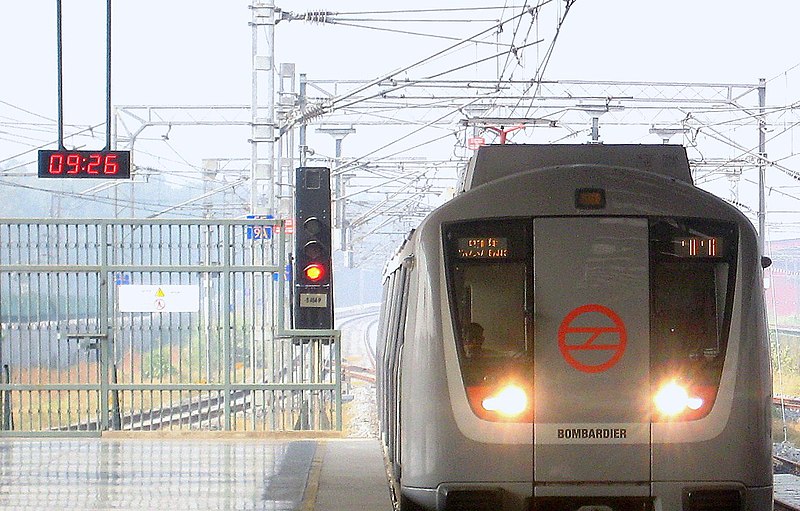
The Delhi Metro, a mass rapid transit system built and operated by Delhi Metro Rail Corporation(DMRC), serves many parts of Delhi as well as the satellite city of Gurgaon in the neighbouring Haryana and Noida in neighbouring Uttar Pradesh. As of October 2010, the metro consists of six operational lines with a total length of 153 km (95 mi) and 130 stations while several other lines are under construction.The Phase-I was built at a cost of US$2.3 billion and the Phase-II will cost an additional US$4.3 billion.Phase-II of the network is under construction and will have a total length of 128 km. It is expected to be completed by 2010. Phase-III and IV will be completed by 2015 and 2020 respectively, creating a network spanning 413.8 km, longer than that of the London Underground.
Auto rickshaws are a popular means of public transportation in Delhi, as they charge a lower fare than taxis. Most run on Compressed Natural Gas (CNG) and are yellow and green in colour. Taxis are not an integral part of Delhi public transport, though they are easily available. Private operators operate most taxis, and most neighborhoods have a taxi stand from which taxis can be ordered or picked up. In addition, air-conditioned radio taxis, which can be ordered by calling a central number, have become increasingly popular, charging a flat rate of  15 per kilometre.
Delhi is a major junction in the rail map of India and is the headquarters of the Northern Railway. The five main railway stations are New Delhi Railway Station, Old Delhi, Nizamuddin Railway Station, Anand Vihar Railway Terminal and Sarai Rohilla. Delhi is connected to other cities through many highways and expressways. Delhi currently has three expressways and three are under construction to connect it with its prosperous and commercial suburbs. The Delhi-Gurgaon Expressway connects Delhi with Gurgaon and the international airport. The DND Flyway and Noida-Greater Noida Expressway connect Delhi with two prosperous suburbs of Noida and Greater Noida.
Indira Gandhi International Airport (DEL) is situated in the western corner of Delhi and serves as the main gateway for the city's domestic and international civilian air traffic. In 2006–07, the airport recorded a traffic of more than 23 million passengers, making it one of the busiest airports in South Asia. A new US$1.93 billion Terminal 3 handles an additional 34 million passengers annually in 2010. Further expansion programs will allow the airport to handle more than 100 million passengers per annum by 2020.
Private vehicles account for 30% of the total demand for transport. At 1922.32 km of road length per 100 km², Delhi has one of the highest road densities in India. Delhi is well connected to other parts of India by five National Highways: NH 1, 2, 8, 10 and 24. Roads in Delhi are maintained by MCD (Municipal Corporation of Delhi), NDMC, Delhi Cantonment Board, Public Works Department (PWD) and Delhi Development Authority.
Delhi's high population growth rate, coupled with high economic growth rate has resulted in an ever increasing demand for transport creating excessive pressure on the city's existent transport infrastructure. As of 2008. Also, the number of vehicles in the metropolitan region, i.e., Delhi NCR is 112 lakhs (11.2 million).In 2008, there were 85 cars in Delhi for every 1,000 of its residents.In order to meet the transport demand in Delhi, the State and Union government started the construction of a mass rapid transit system, including the Delhi Metro. In 1998, theSupreme Court of India ordered all public transport vehicles of Delhi to use compressed natural gas (CNG) as fuel instead of diesel and other hydro-carbons.
Delhi Metro
BRTS
Northern Peripheral Road
Northern Peripheral Road road is being developed under the public private partnership (PPP) model. This stretch will connect Dwarka with National Highway 8 at Kherki Dhaula and will pass Pataudi Road. The NPR stretch has been planned as an alternate link road between Delhi and Gurgaon, and is expected to ease the traffic situation on the Delhi-Gurgaon Expressway. The road will also provide connectivity to the much-touted Reliance-HSIIDC SEZ besides the Garhi Harsaru dry depot.
Much like Delhi, Gurgaon too will have a BRT corridor to decongest traffic on the Northern Peripheral Road. In several sections, the NPR will have provisions for the Bus Rapid Transit (BRT) corridor to ensure smooth flow. The road will be fully developed in March 2012.
Culture :-
Delhi's culture has been influenced by its lengthy history and historic association as the capital of India. This is exemplified by the many monuments of significance found in the city; theArchaeological Survey of India recognises 1200 heritage buildings and 175 monuments in Delhi as national heritage sites.The Old City is the site where the Mughals and the Turkic rulers constructed several architectural marvels like the Jama Masjid (India's largest mosque) and Red Fort. Three World Heritage Sites—the Red Fort, Qutab Minar and Humayun's Tomb—are located in Delhi. Other monuments include the India Gate, the Jantar Mantar (an 18th-century astronomical observatory) and the Purana Qila (a 16th century fortress). The Laxminarayan Temple, Akshardham, the Bahá'í Lotus Temple and the ISKCON Temple are examples of modern architecture. Raj Ghat and associated memorials houses memorials of Mahatma Gandhi and other notable personalities. New Delhi houses several government buildings and official residences reminiscent of the British colonial architecture. Important structures include the Rashtrapati Bhavan, the Secretariat, Rajpath, the Parliament of India and Vijay Chowk. Safdarjung's Tomb is an example of the Mughal gardens style.[File:ISKCON_Temple_in_Delhi.jpg|thumb] Delhi's association and geographic proximity to the capital, New Delhi, has amplified the importance of national events and holidays. National events like Republic Day, Independence Dayand Gandhi Jayanti (Gandhi's birthday) are celebrated with great enthusiasm in Delhi. On India's Independence Day (15 August) the Prime Minister of India addresses the nation from the Red Fort. Most Delhiites celebrate the day by flying kites, which are considered a symbol of freedom.The Republic Day Parade is a large cultural and military parade showcasing India's cultural diversity and military might.Over the centuries Delhi is known for its composite culture, and a festival that symbolizes it truly is the Phool Walon Ki Sair, which takes place each year in September, and where flowers and fans embroidered with flowers, pankha are offered to the shrine of 13th century Sufi saint, Khwaja Bakhtiyar Kaki, along with the Yogmaya Temple also situated in Mehrauli.
Religious festivals include Diwali (the festival of lights), Mahavir Jayanti, Guru Nanak's Birthday, Durga Puja, Holi, Lohri, Chhath, Krishna Janmastami, Maha Shivaratri, Eid ul-Fitr, Moharram and Buddha Jayanti. The Qutub Festival is a cultural event during which performances of musicians and dancers from all over India are showcased at night, with the Qutub Minar as the chosen backdrop of the event. Other events such as Kite Flying Festival, International Mango Festival and Vasant Panchami (the Spring Festival) are held every year in Delhi. The Auto Expo, Asia's largest auto show, is held in Delhi biennially. The World Book Fair, held biannually at the Pragati Maidan, is the second largest exhibition of books in the world with as many as 23 nations participating in the event. Delhi is often regarded as the "Book Capital" of India because of high readership.
Punjabi and Mughlai delicacies like kababs and biryanis are popular in Delhi. The street food there is known to be delicious and includes chaat, golgappe and aloo tikki. Due to Delhi's large cosmopolitan and migrant population, cuisines from every part of India, including Gujarati Rajasthani, Maharashtrian, Bengali, Hyderabadi cuisines, and South Indian food items like idli,sambar and dosa are widely available. Local delicacies include Chaat, Golgappe, Aloo-Tikki andDahi-Papri. There are several food outlets in Delhi serving international cuisine, including Italian,Japanese, Continental, Middle-Eastern, Thai and Chinese. Within the last decade western fast food has become more popular as well. Delhi is very much popular for its food and old traditional restaurants.The rich Punjabi food, with its high oil content and spices, is a specialty of Delhi. 'Chaat' is the spicy Indian snack and offers variety such as Papri, Bhalle-Papri, Aloo Tikiki, Gol Gappe, etc. These are the most preferred evening snack of the Indians, especially women. Global giants such as KFC, Mc Donalds, Nirulas and Wimpys lure children and youth with fast food and continental cuisines. The five-star hotels of Delhi also host some good restaurants that offer exotic Chinese, Continental, Thai, Mughlai and Indian cuisines.
Historically, Delhi has always remained an important trading centre in northern India. Old Delhi still contains legacies of its rich Mughal past, which can be found among the old city's tangle of snaking lanes and teeming bazaars. The dingy markets of the Old City have an eclectic product range, from oil-swamped mango, lime and eggplant pickles, candy-colored herbal potions to silver jewelry, bridal attire, uncut material and linen, spices, sweets. Some of old regal havelis (palatial residences) are still there in the Old City. Chandni Chowk, a three-century-old shopping area, is one of the most popular shopping areas in Delhi for jewellery and Zari saris.Notable among Delhi's arts and crafts are the Zardozi (an embroidery done with gold thread) and Meenakari (the art of enameling). Dilli Haat, Hauz Khas, Pragati Maidan offer a variety of Indian handicrafts and handlooms. Over time Delhi has absorbed a multitude of humanity from across the country and has morphed into an amorphous pool of cultural styles.